
Facebook Ads for Contractors: How Kitchen and Bath Businesses Can Turn Project Photos Into Leads
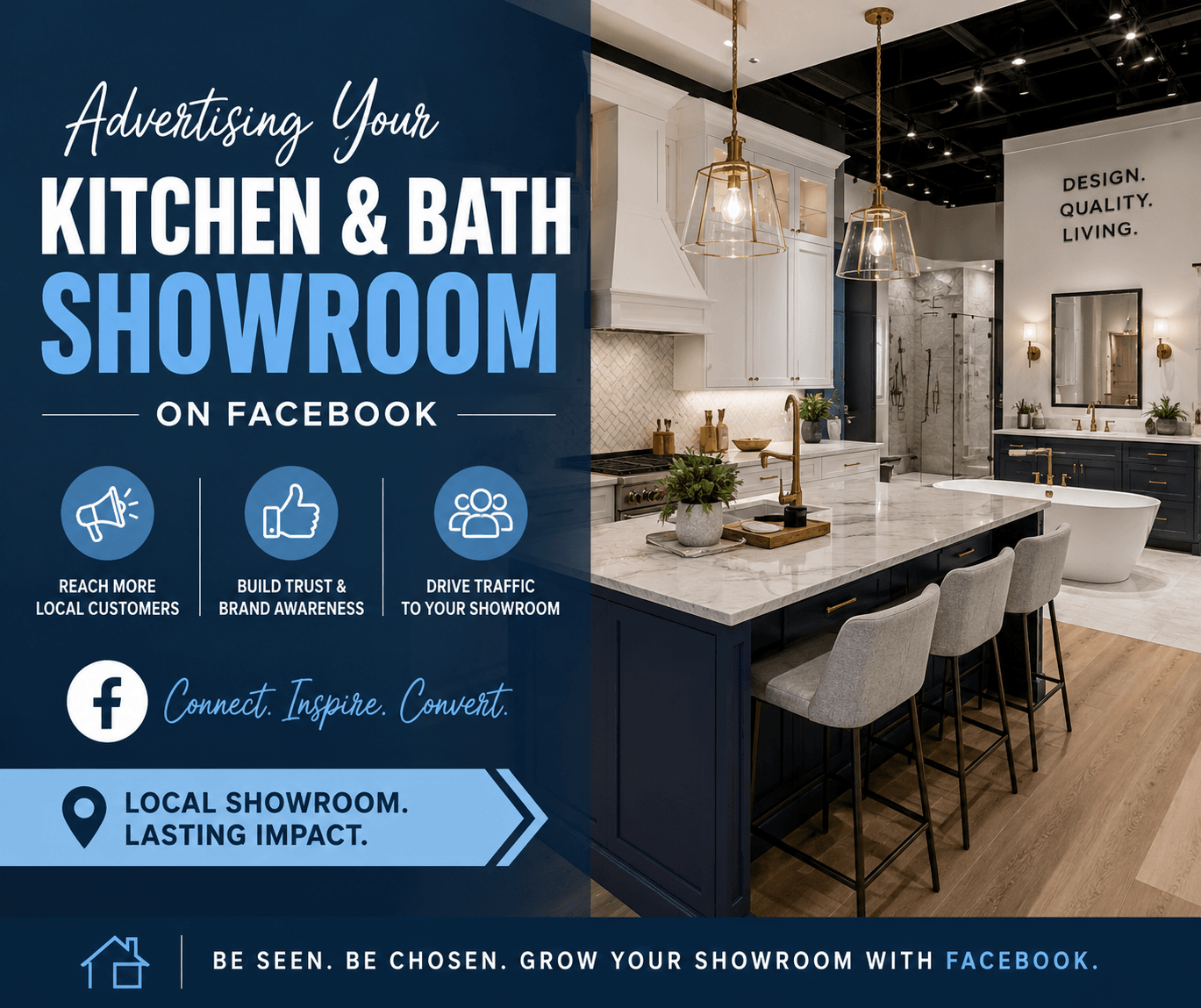
Facebook ads for contractors have quietly become one of the most cost-effective ways to put a kitchen or bath remodel in front of exactly the right homeowner, at exactly the right moment. The photos already exist. The projects are already done. The question is whether those images are working as hard as they could be.
At BKBG, we have watched independent showrooms unlock serious lead generation potential from content they already had on hand. The gap between a scroll and a phone call is smaller than most people think, and we know what it takes to close it.
Why Facebook Ads Work Especially Well for Kitchen and Bath Businesses
Facebook was built around the kind of content kitchen and bath showrooms already produce. The targeting, the format, and the cost structure all align in ways that make it a natural fit for independent showrooms with defined trade areas and visually compelling work.
The Product Sells Itself Visually
Kitchen and bath remodeling is among the most visually driven categories in home improvement. A finished project, photographed well, communicates quality, craftsmanship, and aspiration in a single frame. Facebook and Instagram were built around image and video content, which means the format does a significant portion of the selling before a homeowner ever clicks through. A compelling before-and-after, a short walk-through video, or even a well-lit countertop detail can stop a scroll and hold attention in a way that a text-based ad simply cannot.
Reaching the Right Homeowner at the Right Moment
What separates Facebook from most other advertising channels is the precision of its targeting. You are selecting an audience, not just buying exposure. Showrooms can reach homeowners within a specific zip code radius, filter by household income, and layer in behavioral signals like recent home purchases or life events such as a move. Someone who just bought a house in your trade area and fits your customer profile is a genuinely warm prospect, and Facebook lets you put your work directly in front of them.
Capturing Buyers Before They Start Searching
Google captures demand that already exists. Facebook operates earlier in that process. Most remodeling decisions begin not with a search query but with a slow accumulation of inspiration, a photo saved here, a project admired there, a vague dissatisfaction with a dated kitchen that gradually becomes a real intention to renovate. Facebook puts your showroom into that earlier, formative stage of the decision, so that by the time a prospect is ready to call someone, your brand has already shown up in their feed multiple times.
The Cost Advantage Over Traditional Media
Home shows, print advertising, and direct mail campaigns carry real costs and make attribution difficult. Facebook advertising inverts that model. Budget is controlled at the campaign level, results are measurable in real time, and cost-per-lead data is available without any estimation. For independent showrooms operating with lean marketing budgets, spending five hundred dollars on a targeted campaign and knowing exactly how many people clicked, filled out a form, or called is a fundamentally different proposition than buying a half-page ad in a local magazine.
Local Targeting Is a Genuine Advantage for Showrooms
Facebook's geographic targeting is built for showrooms with a defined trade area. These are the core local targeting levers worth putting to work:
-
Radius targeting lets you draw a precise boundary around your showroom and limit ad delivery to that area, keeping every dollar close to home.
-
City and zip code targeting allows you to focus on specific neighborhoods where your customer profile is most concentrated.
-
Exclusion zones let you trim areas outside your service range so budget is never wasted on impressions that cannot convert.
-
Layered demographic filters combine location with household income and homeownership status to tighten the audience further.
Together, these tools make a modest budget work considerably harder than any broad-reach channel could.
The Foundation: Building a Project Photo Library Worth Advertising With
Great Facebook ads are built on great creative, and for kitchen and bath showrooms, that creative is already walking out the door with every completed project. The difference between a photo that stops a scroll and one that gets ignored usually comes down to a few deliberate choices made on site.
Why Most Contractor Photos Fall Flat
The majority of project photos taken on job sites were never intended as advertising assets, and it shows. Poor lighting flattens the depth and texture that make a kitchen feel luxurious. Cluttered counters and unstaged surfaces pull the eye away from the craftsmanship. Missing before shots eliminate the transformation narrative entirely, which is the single most compelling visual story in home improvement. A photo taken quickly on the way out the door might document the work, but it rarely sells it.
The Before and After Formula
Transformation is the most powerful visual narrative available to a remodeling showroom. A before and after sequence makes the value of the work immediately legible to someone scrolling through their feed. The viewer sees not just a beautiful kitchen but what it replaced, which gives the finished result a weight and significance it would otherwise lack. Capturing a clean before shot at the start of every project costs nothing and pays dividends in every campaign you run afterward.
Practical Photography for Non-Photographers
You do not need a professional photographer on every job site, but you do need a consistent approach. Shoot during golden hour or in full natural light to avoid the flat, unflattering effect of harsh overhead fixtures. Use a wide-angle shot to establish the full room, then move in for detail shots of hardware, tile work, or custom storage. Stage the space before you shoot: clear the counters, add something simple like fresh flowers or fruit, hang clean towels, and remove anything that dates or clutters the scene. Reserve the investment in a professional for flagship projects at your highest price point. A simple checklist kept in your phone is enough to make this a consistent habit across your whole team.
Targeting the Right Homeowners: Audience Strategy
Running a Facebook ad without a defined audience strategy is closer to direct mail than most people realize: you are spending money and hoping the right person happens to see it. The targeting tools available to showrooms today make that kind of guesswork largely unnecessary.
Building Your Core Audience
The starting point for any showroom campaign is a geographic boundary that mirrors your actual trade area. From there, demographic filters let you layer in homeownership status, household income, and age range to concentrate your budget on the people most likely to invest in a kitchen or bath remodel. Interest-based signals, including home improvement, interior design, and real estate browsing behavior, add another layer of relevance. Each filter you add narrows the pool and raises the likelihood that the person seeing your ad has both the means and the motivation to become a real prospect.
Custom and Lookalike Audiences
Your existing customer base is one of the most valuable targeting assets you have. Uploading a past customer list to Facebook allows you to retarget people who already know your showroom, and it unlocks the ability to build a Lookalike Audience, which is Facebook's way of finding new homeowners in your market who share the characteristics of your best customers. Retargeting website visitors works on the same principle: someone who spent time on your project gallery page is already further along in their thinking than a cold prospect, and a well-timed ad can bring them back.
Life Events and Seasonal Timing
Facebook tracks behavioral signals that are directly relevant to remodeling decisions. Life event targeting lets you reach people who have recently moved, recently purchased a home, or just got engaged, all moments when renovation conversations tend to start. Layering in seasonality sharpens this further. Spring is historically the strongest remodel season, and year-end often brings a wave of homeowners looking to spend before the tax calendar resets. Aligning your campaigns with these windows, rather than running at a flat cadence year-round, stretches your budget and improves the quality of the leads you generate.
Content Strategy Beyond the Project Photo: Keeping Your Audience Warm
A retargeting audience that only ever sees finished project photos will go cold. Conversion takes repetition and variety, and the showrooms that build real pipelines on Facebook are the ones feeding their audience a steady mix of content that informs, builds trust, and keeps the brand present through the entire length of a remodeling decision.
Why One Ad Type Is Never Enough
Most remodeling decisions take months to move from vague interest to a real conversation. A homeowner who saw your kitchen remodel photo in February and did not click is not necessarily uninterested. They may simply not be ready yet. Staying in front of that person with content that educates and builds familiarity keeps your showroom relevant through that slow decision process. By the time they are ready to call someone, you want to be the name they already know.
Content Ideas That Keep Your Showroom Top of Mind
The strongest Facebook content calendars for showrooms draw from a range of formats and topics, each serving a different stage of the buyer journey. These are the content types worth building into your rotation:
-
Educational posts answering questions like "What does a kitchen remodel actually cost?" speak directly to early-stage buyers doing research and position your showroom as a trusted, knowledgeable resource.
-
Designer spotlights put a human face on your business and give prospective clients a sense of who they would actually be working with.
-
Trend reports covering cabinet styles, countertop materials, and hardware finishes attract homeowners in the inspiration phase and keep your feed feeling current and authoritative.
-
Client testimonial videos deliver social proof in the most credible format available, a real person describing a real experience in their own words.
-
Behind-the-scenes content from your showroom floor or an active installation builds transparency and familiarity, two qualities that matter enormously when someone is deciding who to trust with a significant home investment.
Rotating through these formats gives your audience a reason to keep engaging with your content long after the first impression.
How Blogging Supports Your Facebook Strategy
A consistently updated blog does two things simultaneously. It gives search engines fresh, relevant content to index, which compounds over time into stronger organic visibility for your showroom. And it gives your Facebook campaigns a steady supply of educational content to promote, which tends to perform well with cold and warm audiences alike. A post answering a question your prospective customers are already searching, boosted as a Facebook ad to a targeted local audience, can generate clicks and awareness at a fraction of the cost of a direct lead generation campaign. The two channels reinforce each other in ways that a social strategy alone cannot replicate.Tying Your Content Calendar to Your Ad Strategy
A social media calendar and a paid ad strategy that operate independently of each other leave real efficiency on the table. The content you post organically tells you a great deal about what your audience responds to, and the posts that generate strong engagement are natural candidates for paid amplification. Running ads against content that has already proven itself with your existing followers reduces risk and tends to produce better results than promoting content cold. Building a simple monthly calendar that maps organic posts to paid promotion windows keeps both efforts aligned and makes the whole system easier to manage.
How BKBG Gives Independent Showrooms a Competitive Edge in Marketing
Independent showrooms are competing against big-box retailers and franchise brands that carry dedicated marketing departments, national ad budgets, and the kind of brand recognition that takes decades to build. At BKBG, we level that playing field by giving our members the tools, resources, and partnerships that make sophisticated marketing achievable without a corporate infrastructure behind it.
The Challenge Independent Showrooms Face
The gap between an independent showroom and a national brand is rarely one of quality or craftsmanship. It shows up in marketing reach and operational capacity. A regional chain can run coordinated campaigns across every channel simultaneously while your team is focused on designing and delivering projects. We exist to close that gap, giving our shareholders access to resources that would otherwise require a full in-house marketing team to develop and manage.
Marketing Resources That Directly Support Your Facebook Strategy
The resources we make available to our members are designed to address the specific barriers that prevent independent showrooms from running effective paid social campaigns consistently. Several of them connect directly to what a strong Facebook strategy requires:
-
Our call-to-action guides are professionally developed content assets that function as premium lead magnets for Facebook Lead Gen ads and landing pages, giving prospects something genuinely useful in exchange for their contact information.
-
The Elevation Blog gives our members a turnkey weekly content resource that keeps their websites fresh and gives their paid social campaigns organic content worth amplifying, removing the time and resource barrier that stops most showrooms from blogging consistently.
-
Our digital marketing Affinity Partners are vetted agencies and website consultants with direct experience in showroom marketing, taking the guesswork out of who to hire when it is time to hand off Facebook ad management to a professional.
-
Business advisory services help ensure that the leads generated by your campaigns actually convert, addressing the processes, staffing, and follow-up systems that determine whether a strong ad strategy produces real revenue.
Each of these resources was built to solve a problem our members encounter in the real operation of their businesses.
The Designer Alliance as a Content Advantage
Our Designer Alliance connects more than 400 showroom designers across the BKBG network. That is a significant content advantage in a marketing context. A network of talented designers produces a steady stream of completed projects, client relationships, and authentic work that paid social campaigns can amplify. The depth and variety of that creative output is difficult to replicate for a showroom operating without that kind of professional community behind it.
The Compound Effect of Tools and Infrastructure Together
Marketing tools and operational infrastructure work best when they reinforce each other. A well-targeted Facebook campaign that generates strong leads means little if the follow-up process is slow or the showroom is too stretched to respond quickly. We give our members both sides of that equation: the marketing resources to generate demand and the business advisory support to make sure the operation is ready to convert it. That combination is what separates sustainable growth from a good month followed by a slow one.
Put Your Best Projects to Work and Watch the Leads Follow
Facebook ads for contractors are only as effective as the strategy behind them. The showrooms generating consistent leads on Facebook share a few things in common: strong creative rooted in real project work, audiences built with intention, and a content mix that keeps prospects engaged through a buying cycle that often spans several months. Getting those fundamentals right does not require a big budget or a dedicated marketing department. It requires consistency, a clear understanding of your audience, and the right tools.
If your showroom is doing great work and the right homeowners are not finding you yet, that is a solvable problem. Reach out to us and let's talk about what it takes to build a Facebook strategy that brings your best projects the attention they deserve.
FAQs
What makes Facebook a better fit for remodeling businesses than other social platforms?
Facebook's combination of detailed demographic targeting and visual ad formats suits remodeling businesses particularly well. You can reach homeowners in a specific zip code, filter by income and life stage, and show them a finished project that speaks directly to their situation. Other platforms offer pieces of that equation. Facebook brings them together in a single campaign structure that works at a local, independent showroom scale.
How much should a kitchen and bath showroom expect to spend on Facebook ads each month?
A meaningful local campaign can start anywhere from three hundred to five hundred dollars a month, with results improving as you gather data and refine your targeting. The more important number to watch is cost per lead, not total spend. Some showrooms generate qualified leads for twenty to forty dollars each. As your creative and targeting improve, that number tends to come down over time.
What type of Facebook ad creative tends to perform best for home remodeling businesses?
Before and after content consistently outperforms single finished-room photos because it tells a story with a clear beginning and end. Short video walkthroughs of completed projects perform well with warm audiences. Educational content addressing cost and process questions tends to generate strong engagement from homeowners in the early research phase. The most effective creative rotates through all three rather than relying on a single format.
How does BKBG's Elevation Blog connect to a showroom's Facebook ad strategy?
We produce the Elevation Blog as a weekly content resource that members can publish directly to their own websites. From a Facebook advertising standpoint, that blog content becomes a library of educational material available for paid promotion. Boosting a well-written post about kitchen remodel costs or cabinet trends to a targeted local audience tends to generate strong engagement and awareness at a lower cost than a direct lead generation ad, making the blog a useful complement to any paid social strategy.
Can BKBG's call-to-action guides be used as lead magnets in Facebook campaigns?
Absolutely. Our call-to-action guides are professionally developed content pieces designed to answer the questions homeowners are already asking. In a Facebook Lead Gen campaign, they work well as the offer: a prospective customer provides their contact information in exchange for access to a genuinely useful guide. We customize each one with the member showroom's logo, contact details, and project photos, so the asset feels native to the brand rather than generic.